

The PRS Database: 100 FAQ's for Landlords
The new PRS database brings plenty of questions for landlords. Who needs to register? What will it cost? Can your agent help? Our comprehensive guide answers 100 frequently asked questions, from the basics to the details that are easy to miss, helping you understand the process, prepare your paperwork and approach registration with more confidence.
100 questions may seem a little extreme... but not when there are possible £7000 fines and upcoming marketing restrictions it's not!
We’ve organised this guide into 11 sections so you can find the answers you need:
🔹Understanding the PRS database;
🔹Who needs to register;
🔹Opening dates and registration deadlines;
🔹Completing the initial registration;
🔹Letting agents and delegated access;
🔹Fees and payment;
🔹Tenancy, rent, licensing and safety information;
🔹Keeping your registration current;
🔹Marketing restrictions,
🔹Public access and later measures;
🔹Mistakes, missed deadlines and enforcement;
🔹Getting organised and how Cope & Co. can help.
Whether you’re starting from scratch or checking a specific detail, there’s no question too basic to ask, and no need to read everything in one sitting. Lets go...

1. What is the PRS database?
The Private Rented Sector database is a national register of landlords and rental properties in England, introduced under the Renters' Rights Act 2025.
The government's registration service is called "Register your rental property". It will bring together information about landlords, their properties and relevant letting and compliance arrangements.
2. Why is the government introducing it?
The intention is to help councils identify rental properties and enforce housing standards, support responsible landlords and eventually give tenants access to relevant information.
It is not intended only for landlords who have done something wrong. It is a registration system covering the relevant private rented sector, including compliant landlords.
3. Is registration compulsory?
Yes, where your letting falls within the scheme and the applicable requirements have taken effect. This is not a voluntary accreditation scheme.
The framework covers landlords of assured and regulated tenancies, subject to the relevant exclusions and exemptions. The size of your property business does not, by itself, determine whether you must register.
4. Does it apply across the whole UK?
No. This database concerns rental properties in England.
Scotland, Wales and Northern Ireland have their own arrangements. Registration elsewhere should not be treated as completing the requirements for an English rental property. Equally, living outside England does not remove the obligations attached to a property you let in England.
5. Am I registering myself or my property?
Both. The system separates the landlord's entry from the property's entry, which the regulations call a dwelling entry.
Creating your landlord entry does not automatically register your properties. Each relevant dwelling needs its own record linked to the appropriate landlord entry or entries.
6. Does it replace property licensing, deposit protection or tax registration?
No. Database registration is an additional requirement, not a replacement for other obligations.
An HMO or selective licence does not register you on the database. Equally, database registration does not grant a property licence, protect a deposit or deal with your tax affairs. Treat each obligation as a separate item on your compliance checklist.
7. Is it the same as the new landlord ombudsman?
No. The PRS database and the planned Private Rented Sector Landlord Ombudsman are separate measures.
The database concerns registration and information. The ombudsman is intended to provide a route for resolving complaints. Their implementation arrangements should not be treated as interchangeable.
8. Does being registered mean my property is officially approved as safe?
Do not treat registration as a blanket safety certificate or a guarantee that every legal requirement has been met.
You must still comply with the underlying safety, licensing and housing rules. Recording a document is not the same as completing any repairs or remedial work identified in it.

9. I only have one rental property. Does this still affect me?
Yes, where it is let under a tenancy covered by the scheme. There is no general exemption simply because you own one property, inherited it, rent out a former home or do not regard yourself as a professional landlord.
The relevant question is the legal nature of the letting, not how you describe your involvement.
10. My tenant has lived there for years. Can I wait until they leave?
No. Existing tenancies are part of the initial rollout.
Registration is not reserved for newly advertised properties or new tenants. A longstanding tenancy can still require registration by the applicable regional deadline.
11. We own the property jointly. Does only one of us register?
Where you are joint landlords, each landlord needs their own landlord entry. The property then has a shared dwelling entry.
The government's explanatory memorandum expressly distinguishes separate landlord registrations from the single property record. Agree who will coordinate the process, but do not assume one person's landlord entry covers every joint landlord.
12. The property belongs to a limited company. Who registers?
The company should be recorded as the landlord where it is the relevant legal landlord.
The registration also identifies the individual making the entry for the organisation and a nominated contact. Company details, including the Companies House number where applicable, form part of the required information.
Do not accidentally register yourself personally as landlord of a company's property.
13. What about trusts, inherited properties or someone acting under a power of attorney?
The draft framework recognises organisational landlords and specified legal representatives, including attorneys and personal representatives administering an estate.
Additional information and evidence of authority may be required. Being a helpful relative or an ordinary managing agent is not, by itself, equivalent to holding one of these legal appointments. Establish who has authority before starting.
14. I live overseas. Am I exempt?
No general exemption arises simply because the landlord lives abroad.
The property record requires a correspondence address in England or Wales, which cannot be a PO Box. Overseas landlords should prepare the appropriate contact arrangements rather than assuming an overseas residential address answers every address question in the registration.
15. I let to a family member or charge below-market rent. Does that make a difference?
Not automatically. A family connection or discounted rent does not, on its own, establish an exemption.
The arrangement's legal classification matters. Very low-rent, rent-free and informal family arrangements can raise different questions, so obtain advice rather than assuming every family letting is either included or excluded.
16. Do I need to register because I have a lodger?
A genuine lodger arrangement involving shared accommodation with a resident landlord will generally fall outside the assured and regulated tenancies covered by the announced scheme.
However, a separate flat within a building you also occupy can present a different situation. The actual arrangement matters more than calling someone a "lodger".
17. What about holiday lets and serviced accommodation?
Genuine holiday lettings are generally outside the assured-tenancy framework.
However, advertising a property as "serviced accommodation" or using a short agreement does not conclusively determine its legal status. Where someone occupies it as their home, obtain advice about the actual arrangement rather than relying on the marketing description.
18. Are student properties included?
Ordinary privately rented student houses can be included where the occupants hold assured tenancies.
Different arrangements apply to certain qualifying purpose-built student accommodation. Do not assume that every property occupied by students is exempt - or that all student accommodation is treated identically.
19. Does an HMO need one registration, or one for every room?
Do not assume that the number of bedrooms, tenancy agreements or property licences automatically determines the number of database entries.
The framework uses the concept of a dwelling, which can be a building or part of one. For separately let rooms, bedsits and converted buildings, check the final service guidance and the property's legal configuration before deciding how many entries and fees apply.
20. What about leasehold flats, mixed-use buildings and rent-to-rent arrangements?
A leasehold flat can still be a qualifying rental dwelling. A shop with a separately let residential flat should not be treated as a single commercial letting without checking the arrangements.
For rent-to-rent and other layered ownership structures, identify the landlord under the relevant residential tenancy. Freeholder and superior-landlord details are separate information fields; ownership alone does not answer every registration question.
21. Are social housing and supported accommodation covered?
The Act's relevant definition excludes social housing. The draft database regulations also provide a specific exemption for qualifying supported exempt accommodation.
This is not a blanket exemption for every property offering support or accommodating a vulnerable tenant. Check whether the accommodation meets the particular statutory definition.

22. When does registration open?
The announced launch date is 15 December 2026, beginning with the West Midlands.
As at this guide's publication date, the service has not opened. Preparing information now is sensible, but starting preparations is not the same as completing registration.
23. What are the regional deadlines?
The government has published the following timetable:
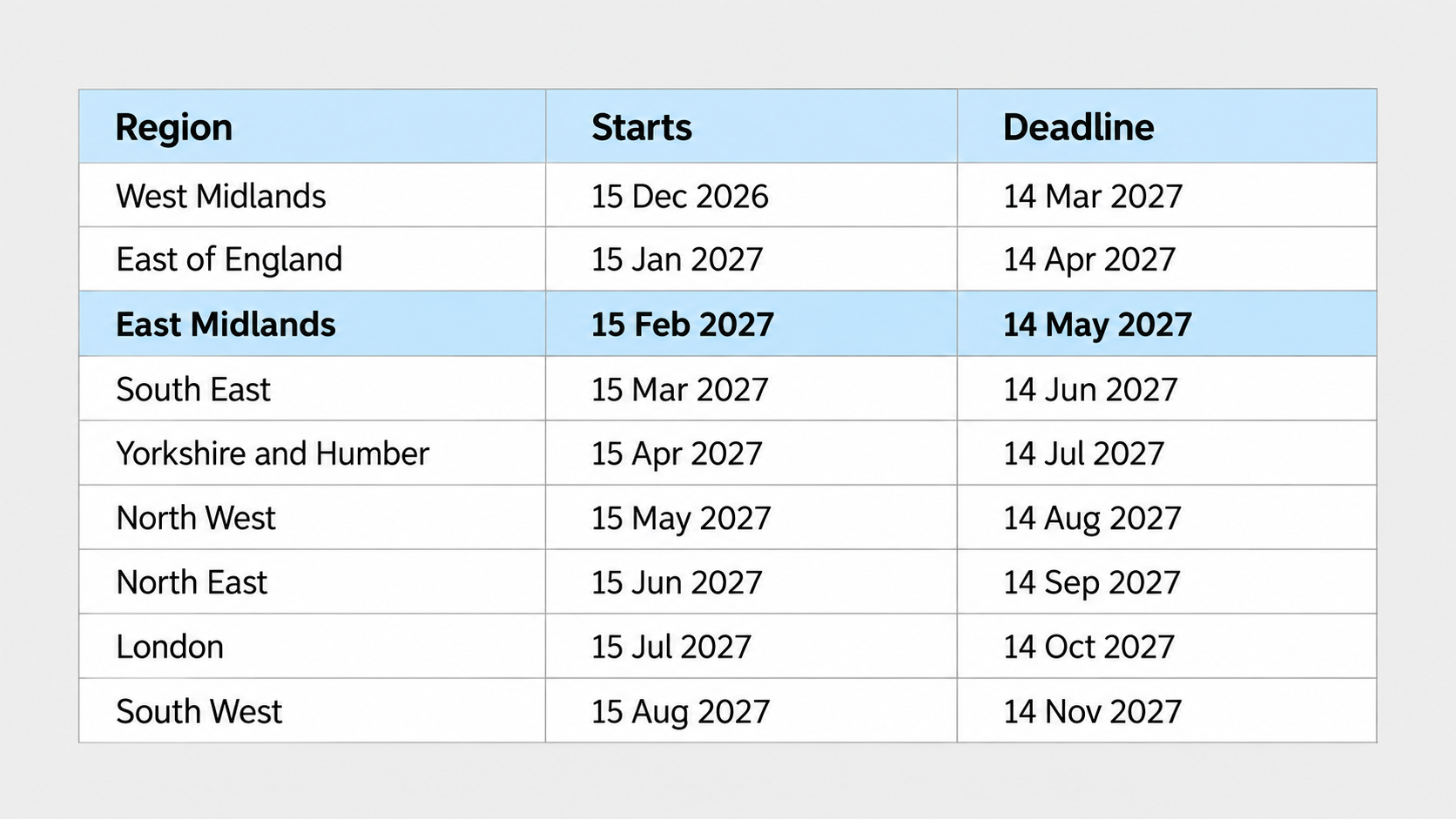
These are regional deadlines - not a single nationwide deadline in November.
24. What does this mean for DE13, DE14 and DE15 properties?
Check the property's actual local authority area, not just its postcode prefix.
Staffordshire addresses fall within the West Midlands timetable; Derbyshire addresses fall within the East Midlands timetable. Some DE15 addresses, including Newton Solney, are in South Derbyshire.
For landlords around Burton, that distinction can mean a deadline two months earlier than expected.
25. Does my home address determine the deadline?
No. The relevant location is the rental property's location.
For example, living in Derbyshire does not move a Staffordshire rental property into the East Midlands registration window. For a portfolio spanning regions, record the applicable deadline against each property.
26. Can I register early or deal with properties in different regions together?
The government says early registration will be available nationally from 15 December 2026, including for landlords wishing to register properties in different regions together.
You do not have to wait for the later regional window, but you must meet each property's applicable deadline.
27. My property is empty. Must I register it during the initial rollout?
The initial requirement concerns properties already let or becoming let during rollout.
The government says unoccupied properties do not yet need registration merely because they may be marketed. Compulsory registration before marketing is a later measure. An existing tenancy should not be treated as ended simply because the tenant is temporarily away.
28. What happens if I start a new tenancy during or after the rollout?
The initial scheme includes properties that become let during rollout.
Do not assume every new tenancy creates a fresh three-month registration window. Check the applicable regional and commencement requirements before the tenancy begins, particularly where the region's original registration deadline has already passed.
29. Can I wait until I receive an individual letter or reminder?
We would not recommend that approach.
Use the published timetable to prepare your own deadlines. Keep a property-by-property record and begin gathering missing information before the relevant window opens. A reminder should support your process, not be the event that starts it.

30. How will I register?
The online service will use GOV.UK One Login. The draft framework also provides for registration through an approved form.
Start through the official government service when it opens. As a practical safeguard, avoid entering identity documents or payment information through unsolicited messages without checking where they lead.
31. I already have a GOV.UK One Login. Does that mean I am registered?
No. One Login is a means of accessing government services; it is not your landlord or property registration.
An existing One Login account may be used to access participating services, but you must still complete the database's required entries and outstanding actions.
32. What personal or company information should I prepare?
Individuals should prepare their name, date of birth, residential address, telephone number and email address.
Organisations need their legal details, relevant registration numbers and information about the people acting for them. Trusts and organisations without a Companies House number have additional requirements. Use the relevant checklist for the legal landlord - not simply whichever person manages the paperwork.
33. What information goes into the initial property record?
The initial record covers the property address, relevant landlord contact and correspondence details, ownership and dwelling type, bedrooms, letting status, and applicable freeholder, superior-landlord and property-manager details.
This is distinct from the supporting tenancy, rent and safety information discussed later in this guide.
34. Why can't my agent simply create the initial entries?
The draft rules reserve initial landlord and property entries to the landlord or specified legally authorised representatives.
An ordinary managing-agent appointment does not give the same authority. Agents have a defined role in supplying supporting information, rather than unrestricted permission to perform every registration step.
35. What if I cannot use an online service?
Offline registration is planned. The government also intends to provide a dedicated support contact centre.
A family member can help you organise information, but practical assistance should not be confused with legal authority to make an entry on someone else's behalf. Use the approved route for your circumstances.
36. Must I have every supporting document ready before creating the property entry?
For an already-let property, the draft rules permit the initial entry without all the supporting tenancy and safety information.
However, omitted supporting information must be supplied within 28 days beginning with the date the property entry was made. We recommend preparing the documents first wherever possible, rather than starting the clock with major gaps unresolved.
37. How will I know registration is actually complete?
Our advice is to retain confirmation, check the status of both the landlord and property entries, and check for outstanding information or declarations.
An "active" property entry during the initial permitted period should not be mistaken for confirmation that every supporting item has been supplied. The draft allows an initial entry before all that information is added.
38. Can I register myself now and leave the properties until much later?
The draft provides for a landlord entry to become inactive if no property entry is linked within three months of its creation.
Preparing the landlord and property stages together is therefore preferable to opening an account and leaving the remaining work indefinitely.
39. What should I do if the application fails or the website displays an error?
Keep dated screenshots, reference numbers and a record of the steps attempted. Contact the service promptly and continue checking until the issue is resolved.
Our recommendation is not to treat an attempted submission or a payment leaving your account as sufficient evidence that every required entry has been successfully completed.

40. Can my letting agent handle the whole process?
Not under the proposed ordinary agent arrangements. Landlords retain the initial-entry responsibilities, while agents can supply specified supporting information.
The safest approach is a written division of work: what the landlord must do, what the agent will do, and who checks that the entire process is finished.
41. How will I give my agent access?
The government has confirmed an agent-support facility, but the detailed official access instructions remain forthcoming.
Do not treat a particular invitation email, screen sequence or portfolio-access arrangement as final until the service guidance is published. Agree the appropriate agency contact in advance, and do not share your personal One Login password.
42. What can the agent help submit?
An appointed agent can provide the supporting information described in Part 2 of Schedule 3: tenancy and occupancy details, rent, licensing, furnishing, utilities and relevant safety and energy documents.
Agree which information the agent already holds and which items you must supply. An incomplete handover can leave important gaps.
43. Can the agent keep everything updated afterwards?
The draft permits agents to update letting status and the specified supporting information.
That does not extend to every field. Personal landlord information and certain basic property details remain outside the ordinary agent's updating permission. Your management arrangements should identify which changes require action from you.
44. What happens when I change letting agents?
Make the database part of the handover.
The recorded property-manager details will need attention, but changing that field is outside the ordinary agent's limited updating permission. You should also arrange appropriate access for the incoming agent and establish responsibility for outstanding work. Do not assume access transfers automatically with the management contract.
45. My property is fully managed. Am I still responsible?
Yes. Using an agent does not remove the landlord's statutory obligation to maintain the required registrations and information.
A fully managed service may provide substantial assistance, but you should still retain confirmation and respond promptly to actions reserved to you. "My agent deals with everything" is not a substitute for checking the agreed responsibilities.
46. Is database support automatically included in my agent's existing fee?
Do not assume so. Ask your agent to explain the service being offered and any related charge.
Clarify whether support covers initial preparation, supporting submissions, ongoing updates, renewal reminders and help resolving problems. A tenant-find service and an ongoing management service may involve very different divisions of work.

47. How much will registration cost?
The announced charge is £65 per property per year.
At the full annual rate, one property costs £65, five cost £325 and ten cost £650. These examples exclude any separate professional assistance you choose to purchase and any initial rollout adjustment.
48. Do joint landlords pay a separate property fee each?
The announced fee is attached to the property, rather than being multiplied by the number of joint landlords.
Joint landlords have individual landlord entries but share the dwelling entry. Coordinate the registration rather than creating duplicate property records for the same letting.
49. Will everybody pay a full £65 immediately?
The government has announced proportional adjustments during rollout. Detailed calculations should be checked in the service when registration opens.
The draft also aligns later property entries with existing property renewal dates in certain circumstances, so do not assume every new property's first registration period will be exactly twelve months.
50. Can my agent pay the fee for me?
The draft requires the relevant fee to be paid by the person making the property entry. Detailed payment functionality still needs clarification.
An agent agreeing to cover a cost is not necessarily the same as being able to make the payment directly through your account. Establish the permitted payment or reimbursement arrangement before relying on it.
51. Can I charge my tenant a separate registration fee?
For tenancies covered by the Tenant Fees Act, landlords and agents cannot require payments outside the permitted categories. A separate PRS database administration charge is not one of those categories.
Do not simply add £65 to a tenant's bill or re-label it as an administration fee.
52. Does every change of tenant mean another registration fee?
The framework provides for fees when a dwelling entry is made, renewed or reactivated in specified circumstances - not a general charge every time a tenant changes.
A tenant change normally calls for checking and updating the existing record. It should not automatically prompt creation of a duplicate property entry.
53. Is £65 guaranteed forever, and are there discounts or refunds?
Do not assume the announced fee is permanently fixed. The draft delegates fee-setting to the database operator within the statutory framework.
We would also avoid budgeting on the assumption of portfolio discounts, instalments or refunds after a sale unless the final payment guidance expressly provides them.
54. Does "number of occupants" mean the number of people named on the tenancy agreement?
The published field asks for the number of occupants, not merely the number of named tenants.
Our recommendation is to check actual occupancy rather than copying the signature page of an old agreement. Where the circumstances are unclear, resolve them rather than guessing.
55. What is the difference between occupants and households?
Occupants are individual people; households concern how those people are related.
For example, a couple living together forms one household, while unrelated friends can form separate households despite sharing one tenancy agreement. The number of agreements therefore does not necessarily equal the number of households.
56. Which rent figure should I record?
The required information concerns the rent charged and payment frequency, together with any included utilities.
Do not substitute the amount your agent transfers after deducting management fees. Check the current agreed rent and record utility arrangements accurately rather than relying on the original advertising particulars.
57. What licensing information is required?
The record asks whether an HMO, additional or selective licence is required and, where available, the relevant licence numbers.
The important question is whether a licence is required, not simply whether a licence happens to be in your paperwork. Check the local authority's requirements where there is any uncertainty.
58. What gas safety information is required?
Where the dwelling has a gas supply, the draft requests the gas safety record, if one exists, and its issue date.
The wording does not remove the underlying duty to obtain the required checks. A missing record should trigger an investigation and appropriate action, not merely an empty upload field.
59. What electrical safety information is required?
The draft requests an EICR, if one exists, or an appropriate Electrical Installation Certificate.
For an EICR, the relevant date is the deadline stated for the next inspection and test. For an EIC, it is the certificate's issue date. Do not automatically treat every electrical document as having the same five-year expiry.
60. What happens if my EPC has expired?
The draft specifically asks for the current tenancy's start date where the most recent EPC is no longer valid.
That does not mean every expired EPC automatically triggers a new certificate within the database's 28-day updating period. Check the separate EPC requirements applying to the tenancy, proposed marketing and any relevant works.
61. What if the property has a low EPC rating or an energy-efficiency exemption?
Where the rating is below the applicable minimum, the database asks whether a registered Minimum Energy Efficiency Standards - MEES - exemption applies and which type.
Recording an exemption on the database does not create one. The exemption must satisfy the separate energy-efficiency rules and be registered through the appropriate process.
62. Must I upload tenant passports, names or the tenancy agreement?
These are not listed as standard required uploads in the published Schedule 3 information requirements.
Do not upload a complete tenant file simply because you have it. Follow the service's actual instructions and avoid supplying unnecessary personal information. Other landlord record-keeping duties remain separate.
63. Will I need brand-new certificates just to register?
The published requirements do not create a blanket rule requiring every landlord to replace otherwise appropriate documents solely for registration.
Check whether each document remains suitable under its own legal rules. For example, electrical inspections may be due sooner than five years where the report specifies an earlier date.
64. What if a certificate is missing, unsatisfactory or difficult to obtain?
First establish whether the document is missing from your files or whether the underlying inspection has not been completed. Those are different problems.
Where work is needed, arrange appropriate professional help. Where access is being refused, keep records and obtain advice about lawful next steps. A database entry does not resolve an unsafe installation or remove the need for remedial action.
65. Does uploading a certificate replace giving it to the tenant?
Do not treat the database as a substitute for complying with document-service duties.
For example, existing tenants must receive the gas safety record within 28 days of the check, while new tenants must receive it before moving in. Track the safety work, the tenant's copy and the database update as separate completion checks.

66. Is registration a one-off exercise?
No. The framework combines initial registration, updates when information changes and periodic renewal.
Annual renewal is not permission to leave an inaccurate record unchanged until the following year. We recommend making database checks part of normal property management rather than maintaining an unrelated annual task.
67. What are the main ongoing deadlines?
Under the published draft:
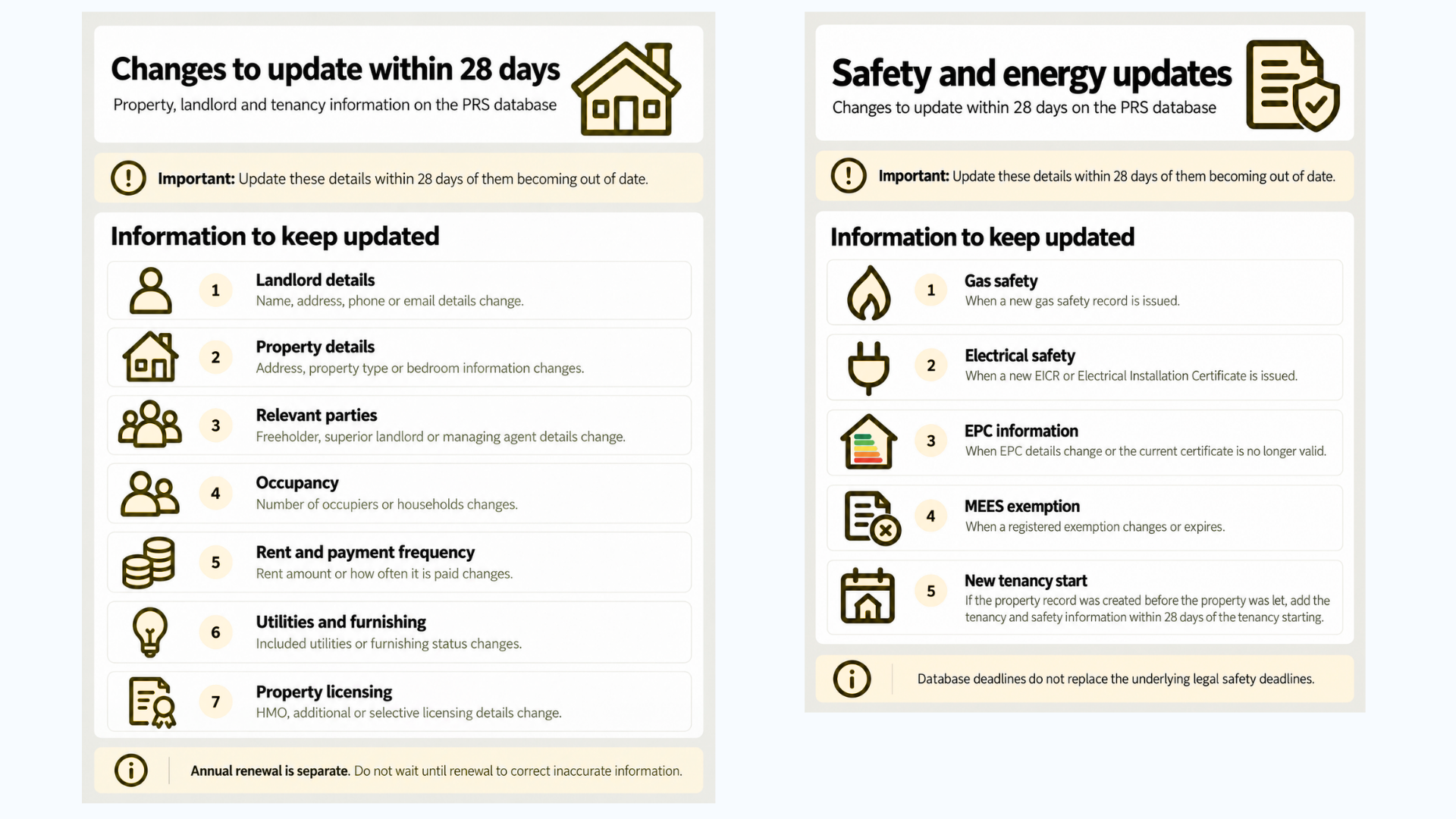
Different events trigger different clocks.
68. Are those 28 working days or calendar days?
They are calendar days. The draft wording counts the day of the relevant event as day one.
For example, applying that wording to information becoming out of date on 1 July 2027 produces a deadline of 28 July 2027. Do not add weekends or wait until the following month's management review.
69. When should the database rent change - when notice is served or when the increase starts?
The relevant field records rent charged. Applying the updating rule, the trigger is when the new rent takes effect, not merely when a future increase is proposed.
Likewise, a missed payment does not, by itself, change the agreed rent. Avoid replacing the rent figure with whatever happened to be received that month.
70. What changes to contact or property details need attention?
Examples include changes to required landlord contact details, property information and relevant managing-agent, freeholder or superior-landlord details.
Check who is permitted to amend the particular field. The agent's updating authority is limited, so some changes must be completed by the landlord or a specified legal representative.
71. What happens when a safety certificate is renewed?
Review the corresponding database document and date as part of the renewal process. For a let property, outdated information falls within the draft's 28-day updating rule.
Our recommendation is to update promptly once the replacement is available, rather than using the full period routinely. Keep the underlying safety deadline separate.
72. What should happen when a tenant leaves?
Review the letting status, check outstanding information and prepare the record for the next letting.
There is an important qualification: the draft's general property-updating rule refers to a dwelling that is let under a residential tenancy. It should not be presented as a universal permission to leave every vacancy-related action for 28 days.
73. Does the "28 days after a tenancy starts" rule mean I can let an unregistered property for four weeks?
No. That provision addresses supporting information for an existing active property entry created before the tenancy began.
It is not a general four-week exemption from registering the landlord and property, and it does not override later requirements to register before marketing.
74. How often must registration be renewed?
The draft normally provides for renewal every twelve months. Both landlord and dwelling entries have renewal requirements, with a fee attached to renewing the dwelling entry.
Use the renewal date recorded for the entry rather than estimating it from memory.
75. Will every property in my portfolio have a different renewal date?
Not necessarily. The draft generally aligns a second or subsequent dwelling entry with the renewal date of existing dwelling entries for the relevant landlord.
This means a recently added property may reach its first renewal sooner than twelve months after it was added. Joint-landlord arrangements also need careful checking.
76. Is there a 28-day grace period after annual renewal is due?
No general grace period of that kind appears in the draft.
An active entry becomes inactive the day after its renewal date unless renewed on or before that date. The 28-day information-updating rules and the annual renewal deadline are separate obligations.
77. Why might an entry become inactive?
Non-renewal is one reason. Others include failure to provide the initial supporting information within the permitted period, voluntary deactivation and specified circumstances affecting eligibility.
A landlord entry can also become inactive where no property is linked within three months, or all linked property entries become inactive. Special provisions apply in certain representative cases.
78. What happens if I sell, transfer ownership or stop being a landlord?
Treat these as changes requiring a registration review, not merely an alteration to a payment reference.
A transfer into a company can involve a different legal landlord. A sale should include clear responsibility for the incoming landlord's arrangements. The draft normally permits only one active dwelling entry, with a narrow sale-related exception; do not create duplicates casually.
79. Can my agent reactivate an inactive entry?
The draft's reactivation provisions are reserved to the landlord and specified legally authorised representatives, rather than giving ordinary agents a general reactivation power.
Reactivation may require missing information, an active linked landlord entry and, in some circumstances, payment. An agent may help prepare what is needed without being authorised to perform every step. 
80. Do all database requirements start when registration opens?
No. The initial registration rollout is separate from later requirements concerning unoccupied properties before marketing, registration identifiers in adverts and public access.
Those later measures should not be assigned the launch date simply because they form part of the overall database framework.
81. Could an inactive registration prevent me advertising after my tenant leaves?
Yes, once the later marketing restriction applies. The required landlord and property entries must be active before marketing.
At that point, promising to register before the next tenant moves in will not be sufficient. An unresolved registration problem could delay remarketing and extend a void period.
82. Will registration numbers have to appear in adverts?
Under the later advertising provisions, written advertisements must include the relevant landlord and dwelling identifiers.
The rules cover advertising by landlords as well as agents. This is a later requirement - not something to describe as automatically compulsory from the service's first day.
83. Will tenants see my home address, date of birth and all my documents?
Do not assume that everything collected will be publicly displayed.
The Act separates information held on the database from information made public under further regulations. The final public-facing fields remain to be specified. It would be equally unwise to promise that a particular detail can never become accessible without checking those final rules.
84. Will councils or HMRC be able to access the information?
The Act provides access for specified public authorities, including local housing authorities, and controls disclosure of restricted information.
It is not accurate to describe the database as either completely private or freely available to every organisation. Do not assume automatic unrestricted HMRC access - or that database registration replaces tax reporting. Detailed sharing arrangements require the appropriate legal authority.
85. Will there be automatic reminders, bulk uploads or links to my agent's software?
Do not build your compliance process around features that have not been confirmed in final service instructions.
Our recommendation is to maintain your own deadline tracker until you know how reminders, delegated access and any bulk-management facilities work in practice. Helpful software is a safeguard, not a reason to leave responsibility unassigned.

86. What happens if I miss the registration deadline?
Once the relevant duty applies, a breach can lead to a financial penalty of up to £7,000.
That is a maximum, not an automatic charge for every error. However, registering late should not be treated as a risk-free option simply because you intend to complete it eventually.
87. When can the penalty increase to £40,000 or become a criminal matter?
The Act creates specific offences, including certain continuing breaches after a financial penalty, further breaches within the relevant five-year period and knowingly or recklessly supplying materially false information.
For qualifying offences, the council can impose a financial penalty of up to £40,000 as an alternative to prosecution. The precise statutory conditions matter.
88. Does an innocent typing mistake amount to fraud?
Not automatically. The false-information offence concerns information that is materially false or misleading and supplied knowingly or recklessly.
Nevertheless, mistakes should be corrected promptly. We recommend keeping a record of the error, when it was discovered and how it was corrected, particularly where it affects identity, ownership or compliance information.
89. Does paying a penalty mean I can remain unregistered?
No. A penalty does not purchase permission to continue the breach.
The Act allows escalating consequences where non-compliance continues beyond the relevant statutory period after a penalty, subject to the appeal provisions. Resolve the registration problem as well as dealing with the notice.
90. Could I have to repay rent?
Potentially, but a missed deadline does not automatically produce a rent repayment order.
The Act adds particular database offences to the rent repayment framework, including specified continuing registration breaches and false-information offences. Qualifying cases can expose a landlord to repayment of up to two years' eligible rent, subject to the offence, relevant period and tribunal decision - not automatically every payment received in the previous two years.
91. Could registration problems stop me recovering possession?
Once the relevant restriction applies, a court cannot make the specified possession order while the landlord - or any joint landlord - is in breach of the duty to maintain active landlord and property entries.
The exceptions concern Ground 7A and Ground 14, involving antisocial behaviour. Correcting registration removes this particular barrier; it does not guarantee possession or replace the ordinary legal requirements.
92. Does an unregistered property mean the tenancy is invalid or rent is no longer payable?
No. The Act expressly states that the relevant registration and marketing breaches do not, because of that illegality, invalidate the tenancy or contract.
A tenant should not assume registration failure automatically permits rent withholding. Rent repayment proceedings, possession restrictions and the continuing tenancy are separate issues.
93. Can the information I submit be checked?
Yes. The draft permits the database operator and local housing authorities to verify entries, and allows the operator to correct errors or remove entries that do not meet the requirements.
Treat the information as a formal record. Do not fill gaps with estimates simply to move through the form.
94. Can I challenge a financial penalty?
Yes. The statutory procedure includes a notice process and a right to appeal a final penalty to the First-tier Tribunal.
The Act specifies a 28-day appeal period beginning the day after the final notice is given. Take advice promptly, follow the notice carefully and do not confuse an appeal with correcting the underlying registration issue.
95. What should I do if I discover that a deadline has already been missed?
Act promptly. Establish which entry or information is missing, contact the service where necessary and complete the required corrective steps.
Keep evidence of technical problems, communications and action taken. Do not assume that an agent's oversight or a website error automatically grants an extension. Obtain legal advice if enforcement or possession proceedings are involved.

96. How can Cope & Co. help?
We can help you prepare the information for each property, identify missing documents and understand which actions need to come from you.
Where agreed and permitted, support can include supplying the supporting information and helping maintain relevant records. We will explain the support available through your service and agree responsibilities, rather than leaving either party to assume the other has completed everything.
97. What should I do before registration opens?
Our recommendation is to create a registration folder for each property containing the legal landlord's details, the property information, current letting arrangements and relevant compliance documents.
Check the correct regional deadline and resolve obvious gaps early. Also agree who will handle each stage and which person will confirm that the complete process - not just the first entry - has been finished.
98. How should I organise a property portfolio?
Use a simple tracker with one row per property. Record the legal landlord, relevant region, registration status, outstanding information, responsible person and next deadline.
Once available, add registration identifiers and actual renewal dates. Keep personal and company ownership clearly separated, and do not assume that every property has identical responsibilities or dates.
99. What practical routine would Cope & Co. recommend after registration?
Build a database check into rent changes, tenancy changes, certificate renewals and management handovers.
We suggest an internal target of dealing with routine updates within seven days, plus renewal reminders well in advance. That seven-day target is our suggested safeguard, not an additional legal deadline. Record completion, rather than merely recording that someone was asked to do it.
100. What still needs checking before I rely on a complete step-by-step guide?
Final regulations and operating instructions should be checked for the exact agent-access process, payment methods, identity checks, complex property arrangements and later marketing and public-access dates.
Our advice is straightforward: prepare early, work from the correct regional deadline and keep a clear record of who is responsible for each action. The detailed regulations are still published in draft, so preparation should not become an assumption that every operating detail is settled. (Legislation.gov.uk)
Need help preparing?
Whether you have one rental property or a larger portfolio, speak to the Cope & Co. team about organising the information and putting the right support in place.
Look out for further registration guidance, including the steps landlords need to complete themselves and the supporting work an appointed agent can help with.
This guide provides general information for landlords in England. It is not a substitute for advice on an individual tenancy, ownership structure, enforcement notice or possession case. Check the final regulations and current official guidance before acting, particularly where your circumstances are unusual.